 how-to
How to Choose Baby Sweater Sizes: A Parent's Guide
Table of Contents
- Why Baby Sweater Sizes Vary So Much
- Your Baby Sweater Size Chart: Age, Weight, and Height
- How to Measure a Baby for a Sweater
- Understanding Ease in Knitting and Crochet Patterns
- Choosing Baby Gift Sizes Without the Guesswork
- How Yarn Weight and Needle Size Affect Finished Dimensions
- Seasonal and Garment Style Considerations
- Frequently Asked Questions
Last Updated: September 17, 2026
Why Baby Sweater Sizes Vary So Much
Baby sweater sizes labeled "6 months" from one maker can fit a 3-month-old in another brand. Brands use different growth charts, ease allowances, and yarn weights. At Custom Knits for Baby, we knit each piece to order, so we think about fit differently than a factory does.

Your Baby Sweater Size Chart: Age, Weight, and Height
A baby sweater size chart works best as a range, not a fixed rule. Use it as a starting point, then check it against your baby's actual measurements.
| Size | Typical Age | Weight | Height |
|---|---|---|---|
| Preemie | Up to 1 month | 5-8 lb | 17-19 in |
| Newborn | 0-1 month | 7-10 lb | 19-21 in |
| 6 mos | 3-6 months | 12-17 lb | 24-26 in |
| 12 mos | 6-12 months | 17-22 lb | 27-29 in |
| 18 mos | 12-18 months | 22-27 lb | 30-32 in |
| 2T | 18-24 months | 27-30 lb | 33-35 in |
| 3T | 2-3 years | 30-33 lb | 36-38 in |
Reading Standard Sizing Labels
Standard sizing labels rarely match across brands, one maker's "12 mos" can run small, another's roomy. Always check finished garment measurements over the age range. If a shop lists chest width and body length, trust those numbers.
When to Size Up for Growth Spurts
Size up when your baby sits near the top of a size range, not the middle. A baby at 16 lb fits "6 mos" today but may outgrow it within weeks. Buy one size ahead for a longer window of wear; avoid two sizes up, since an oversized sweater slips off shoulders and bunches at the wrists.
How to Measure a Baby for a Sweater
To measure a baby for a sweater, you need three numbers: chest circumference, torso length, and sleeve length. Use a soft tape over light clothing, snug but not tight. If your baby wiggles, measure twice and average.
Here's the order that works best:
- Lay your baby flat on a changing table or bed
- Measure chest circumference at the fullest point
- Measure torso length from shoulder to hip
- Measure from the center back neck to the wrist
- Write each number down before your baby moves
Chest Circumference and Torso Length
Chest circumference is the distance around the fullest part of the chest, just under the arms, and it decides the sweater's width. Torso length runs from the top of the shoulder to the hip bone. A sweater that's wide enough but too short rides up all day, so both matter equally.
Sleeve Length and Center Back Measurements
Sleeve length for a baby sweater is usually measured from the center back neck to the wrist, the center back or neck-to-wrist measurement. It accounts for shoulder slope, so the sleeve ends where it should; measuring just the arm gives you a sleeve that's too short.
Understanding Ease in Knitting and Crochet Patterns
Ease is the extra room built into a garment beyond the body measurement. Positive ease means the sweater is larger than the body. Negative ease means it's smaller and stretches to fit. Most baby sweaters use positive ease so the piece slips on easily and leaves room to grow.
- Snug fit: 0-1 inch positive ease
- Classic fit: 2-3 inches positive ease
- Room to grow: 4+ inches positive ease
Choosing Baby Gift Sizes Without the Guesswork
Choosing baby gift sizes comes down to one rule: when in doubt, size up. A sweater that's slightly big gets worn now and again in two months; one that's too small gets returned or tucked away.
A few practical moves make gifting easier:
- Ask the parents for the baby's current weight and height
- Check the due date if the shower is before birth
- Pick a size that covers the next season, not today
- Choose a style that works layered or alone
How Yarn Weight and Needle Size Affect Finished Dimensions
Two sweaters knit from the same pattern can end up different sizes, usually because of yarn weight and needle size. A heavier yarn on larger needles produces a bigger, looser fabric; the same pattern in a finer yarn comes out smaller and denser. Most sizing guides skip this gap: they tell you what size to pick, but not how your hands and yarn change the finished garment.
The Gauge Math That Actually Changes Fit
Gauge is the number of stitches and rows per inch, the single biggest variable between a sweater that fits and one that doesn't.
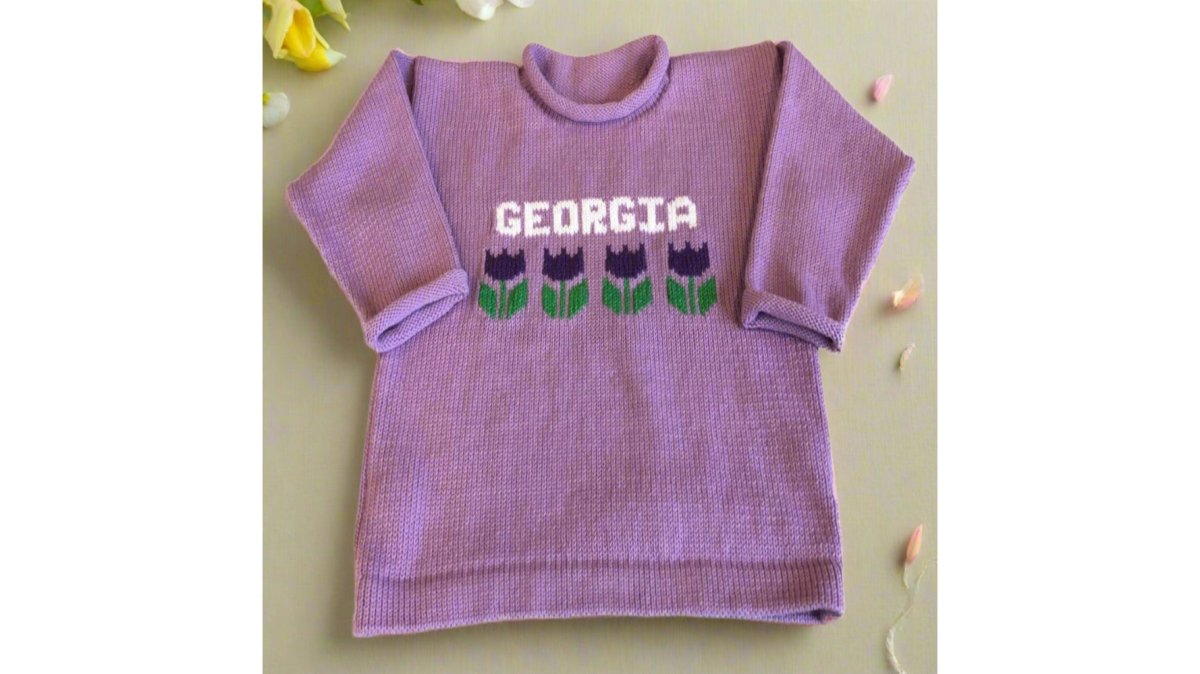
Personalized Baby Name Sweater with →
Why Cotton Behaves Differently
Cotton has little natural memory. It doesn't stretch back the way other fibers do, and it can relax or shrink slightly after the first wash, so the dimensions you measure off the needles aren't always the dimensions the baby wears.
A few practical consequences:
- Swatch, wash, dry, then measure. A cotton swatch that measures 5 stitches per inch off the needles may measure 5.5 after washing. That change compounds across a whole sweater.
- Block to the finished measurements, not to the swatch. Pin the washed swatch to the pattern's stated gauge and see whether it holds.
- Expect less recovery at cuffs and necklines. Cotton ribbing relaxes with wear, so a neckline that fits snugly on day one may loosen over a season.
- Weigh the yarn, not just the yardage. Cotton is denser than most fibers, so the same yardage weighs more and hangs heavier on small shoulders.
Matching Yarn Weight to the Size You Are Knitting
Yarn weight and needle size move together. A thicker yarn on a larger needle makes a bigger fabric per stitch, which is why the same pattern scales differently across weights.
- Fingering weight: fine and light, best for tiny sizes where bulk would swallow the baby
- Sport weight: slightly thicker, a good middle ground for year-round wear
- Worsted weight: medium and quick to work, the most common choice for everyday baby sweaters
- Bulky weight: thick and warm, best for outer layers that go over other clothes
A Quick Gauge Check Before You Commit
Before you knit the body, measure the swatch three ways: off the needles, after washing, and after drying flat. Write all three numbers down. If the washed gauge matches the pattern, proceed; if it's off by more than a quarter stitch per inch, change needle size and swatch again. A half hour of swatching saves a sweater that fits no one.
Seasonal and Garment Style Considerations
Season changes what size you should buy, and garment style changes how that size behaves on the body. A winter cardigan and a summer pullover in the same labeled size fit differently, because ease, layering, and construction all pull on the same measurement.
Sizing for the Season the Sweater Will Be Worn
The rule is simple: size for the layers underneath, not today's weather. A summer sweater gets worn over a onesie or light tee, so it can fit closer to the body with 1-2 inches of positive ease. A winter layer goes over long sleeves, a bodysuit, and sometimes a vest, so it needs 3-4 inches of ease for arm movement.
A practical seasonal calendar:
- Spring babies: a 6-month size often lands in summer, so choose a lighter gauge and 1-2 inches of ease
- Summer babies: a 6-month size lands in winter, so size up for layers and pick a warmer gauge
- Fall babies: a 6-month size lands in spring, a good window for a classic-fit pullover
- Winter babies: a 6-month size lands in summer, so a cardigan in a lighter gauge gets more wear
How Garment Construction Changes the Size You Need
Two sweaters with the same chest measurement can fit very differently depending on construction. The three you'll see most often are raglan, set-in sleeve, and drop-shoulder.
Matching Style to the Size You Pick
Use this table as a starting point, then adjust for the season and the layers underneath.
| Style | Ease Needed | Best For |
|---|---|---|
| Cardigan | 1-2 in | Newborns, easy changes, summer layers |
| Pullover, wide neck | 2-3 in | Everyday wear, raglan construction |
| Pullover, crew neck | 3-4 in | Older babies, winter layering |
| Vest | 2-3 in | Mild weather, over sleeves |
| Drop-shoulder | 3-4 in | 12 months and up, relaxed fit |
The Decision Order That Works
Start with the season the sweater will be worn. That tells you how many layers go underneath. Then pick the construction that matches the baby's age and the parents' patience for dressing. Then choose the size that gives you the ease you need. A sweater that fits well now and still fits in two months is the goal.
Frequently Asked Questions
Is 3-month baby clothing size 0-3 or 3-6 months?
A 3-month size typically refers to the 0-3 month range, meaning it fits babies from birth up to about 3 months. The 3-6 month size is designed for babies already in that older range. Always check the specific brand's baby sweater size chart because labels vary. If your baby is at the top of a range, size up for longer wear.
What age is a 22-inch chest measurement for a baby sweater?
A 22-inch chest circumference usually corresponds to a 12-18 month size in most baby sweater size charts. However, babies grow at different rates, so use chest circumference along with weight and height for the best fit. If you are knitting or crocheting, compare the pattern's finished garment measurements to the baby's actual chest plus desired ease.
Can a 7-pound newborn wear 0-3 month size clothing?
Yes, a 7-pound newborn can often wear 0-3 month size, but it may be roomy. Newborn or preemie sizes fit 5-8 pound babies more snugly. For a sweater, a slightly larger size allows layering and longer wear. Check the brand's size chart and consider how you want the garment to fit before ordering.
What size should I knit for a 6-month-old baby?
For a 6-month-old, most patterns recommend the 6-month or 6-12 month size, depending on the intended fit. Measure the baby's chest circumference and add the pattern's suggested positive ease. If you are choosing baby gift sizes for a baby who will grow into it, size up to 12 months. Always swatch to match the pattern gauge.