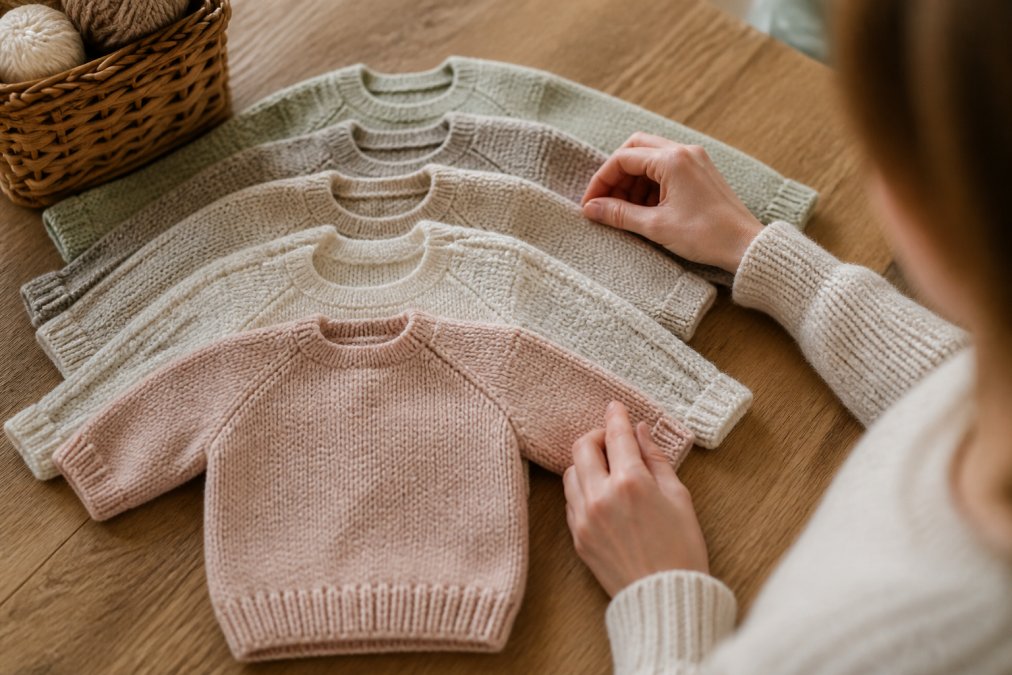
 how-to
Hand Knit Newborn Sweater Sizing Guide
Table of Contents
- Why Hand Knit Newborn Sweater Sizing Differs from Store-Bought
- Standard Baby Sweater Chest Measurements by Age
- Newborn vs. 0-3 Month Sizing Guide: What the Labels Actually Mean
- How to Measure Your Baby for a Custom Knit Sweater
- Garment Ease, Yarn Weight, and Gauge: Sizing the Smart Way
- How to Order Custom Knit Sweaters for Twins
- Common Sizing Mistakes to Avoid
- Frequently Asked Questions
Why Hand Knit Newborn Sweater Sizing Differs from Store-Bought
Hand knit newborn sweater sizing solves a problem that store-bought labels never address: knitted fabric behaves differently from woven fabric. Store-bought garments are cut from rigid woven fabric with predictable stretch, while knitted fabric has built-in elasticity that varies by stitch pattern, yarn fiber, and how tightly the knitter works. A "3-month" label on a mass-produced onesie and a "3-month" hand-knit sweater can have chest measurements that differ by several centimeters.
Hand-knit sizing accounts for garment ease (the difference between body measurement and finished garment measurement), yarn weight, and gauge in ways that factory sizing never does. A bulky-yarn sweater needs more ease than a fingering-weight one. A ribbed body pulls in more than stockinette.
The practical takeaway: always size a hand-knit sweater by actual body measurements, not by the age label on the tag.
Standard Baby Sweater Chest Measurements by Age
Standard baby sweater chest measurements give you the foundation for every sizing decision. Body measurements are the starting point; finished garment measurements add ease on top.
Chest, Length, and Sleeve Measurements at a Glance
The table below shows typical body measurements for infants and toddlers. These are chest circumference measurements taken directly on the body, not finished garment measurements. Your knitter adds ease to these numbers when constructing the sweater.
| Age Range | Chest Circumference | Length (Shoulder to Hem) | Sleeve Length |
|---|---|---|---|
| Premature | 11-13 in / 28-33 cm | 7-8 in / 18-20 cm | 5-6 in / 13-15 cm |
| Newborn | 13-14 in / 33-36 cm | 9-10 in / 23-25 cm | 6-7 in / 15-18 cm |
| 0-3 Months | 14-15 in / 36-38 cm | 10-11 in / 25-28 cm | 7-8 in / 18-20 cm |
| 3-6 Months | 15-16 in / 38-41 cm | 11-12 in / 28-30 cm | 8-9 in / 20-23 cm |
| 6-12 Months | 16-18 in / 41-46 cm | 12-13 in / 30-33 cm | 9-10 in / 23-25 cm |
| 12-18 Months | 18-19 in / 46-48 cm | 13-14 in / 33-36 cm | 10-11 in / 25-28 cm |
| 24 Months | 19-20 in / 48-51 cm | 14-15 in / 36-38 cm | 11-12 in / 28-30 cm |
Armhole depth typically runs 3-4 inches for newborn through 6-month sizes and increases to 4-5 inches for 12-month through 24-month sizes.
Toddler vs. Infant Sizing: Where the Ranges Split
Infant sizing (newborn through 12 months) prioritizes chest circumference and length from shoulder because babies grow fastest in torso length during this window. Toddler sizing (12 months through 24 months and beyond) shifts emphasis toward sleeve length and armhole depth, because arm range of motion matters more once a child is mobile.
The practical split point is around 18 inches of chest circumference. Below that number, you're fitting an infant. Above it, you're fitting a toddler, and the proportions of the sweater change accordingly.
Newborn vs. 0-3 Month Sizing Guide: What the Labels Actually Mean
Newborn and 0-3 month are not the same size, even though many parents use the terms interchangeably. This is the single most common source of sizing confusion.
Newborn sizing is designed for babies born at approximately 7-8 pounds with a chest circumference of 13-14 inches. 0-3 month sizing assumes a baby who has already grown past birth weight, typically 10-13 pounds, with a chest circumference of 14-15 inches. That one-inch difference in chest circumference is enough to make a newborn-sized sweater unwearable by week six, and an 0-3 month sweater too loose in the first weeks of life.
For a hand-knit piece ordered before the baby arrives, many knitters recommend ordering the 0-3 month size with minimal ease. Most newborns reach 0-3 month proportions within four to six weeks, which extends the wear window significantly. The Craft Yarn Council's standard sizing guidelines for baby garments provide a widely used reference for these distinctions.
How to Measure Your Baby for a Custom Knit Sweater
Accurate body measurements are the foundation of a well-fitting custom piece. Taking them correctly takes less than five minutes and saves weeks of back-and-forth.
What You'll Need Before You Measure
- A soft fabric measuring tape (not a rigid metal one)
- A notepad or your phone to record results
- A second person to hold the baby steady (optional but helpful)
- A calm baby, ideally after a feeding
Step-by-Step Measuring Instructions
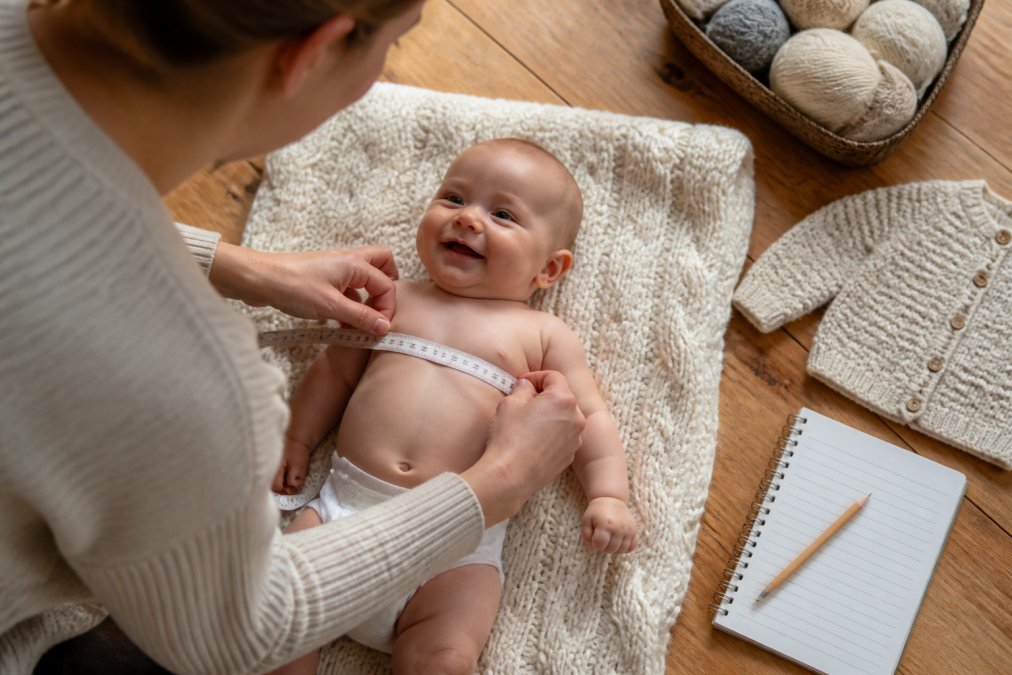
Step 1: Chest circumference. Wrap the measuring tape around the fullest part of the chest, just under the armpits. Keep the tape snug but not tight. You should be able to slip one finger underneath. Record in both inches and centimeters.
Step 2: Length from shoulder to hem. Place the tape at the highest point of the shoulder (where a seam would sit) and measure straight down to where you want the sweater to end, typically at the hip or just below. For newborns, 9-10 inches is standard.
Step 3: Sleeve length. Bend the baby's arm slightly at the elbow. Measure from the top of the shoulder down to the wrist. For newborn sizing, 6-7 inches is typical.
Step 4: Armhole depth. Measure from the shoulder seam point straight down to the underarm. This measurement determines whether the sweater will restrict arm movement.
Once you have these four measurements, compare them against the size chart above. Order the size whose chest circumference is closest to your baby's actual measurement, then note any adjustments needed for length or sleeve.
Garment Ease, Yarn Weight, and Gauge: Sizing the Smart Way
Most sizing mistakes happen here. Ease is the intentional difference between body measurements and finished garment measurements, and getting it wrong produces a sweater that either binds or swamps.
How to Calculate Positive Ease for Different Yarn Weights
Positive ease is the extra room built into a garment beyond the body measurement. For baby sweaters, positive ease keeps the piece comfortable, easy to put on, and forgiving of rapid growth. The amount of positive ease needed depends directly on yarn weight, because heavier yarns produce thicker fabric that takes up more space around the body.
| Yarn Weight | Recommended Positive Ease | Finished Chest = Body Measurement + |
|---|---|---|
| Fingering / Sock | 1-1.5 in / 2.5-4 cm | +1 to 1.5 inches |
| DK / Light Worsted | 1.5-2 in / 4-5 cm | +1.5 to 2 inches |
| Worsted | 2-2.5 in / 5-6.5 cm | +2 to 2.5 inches |
| Bulky | 2.5-3 in / 6.5-7.5 cm | +2.5 to 3 inches |
A common mistake is applying the same ease to every yarn weight. A worsted-weight sweater with only one inch of ease will feel restrictive. A fingering-weight sweater with three inches of ease will look shapeless.
Gauge, the number of stitches and rows per inch produced by a specific yarn and needle combination, determines how the knitter translates these measurements into stitch counts. A gauge swatch knitted and blocked before starting the project is the only reliable way to verify that the finished garment will match the intended measurements. According to the Craft Yarn Council's gauge and swatch guidance, even experienced knitters should swatch for every new yarn and project.
Building in Growth Spurt Allowance
Babies don't grow at a steady rate. A practical approach: add one full size of ease beyond the current measurement for any sweater intended as a gift before the baby is born. For a baby currently measuring at newborn proportions, order to 0-3 month finished measurements. For a 3-month-old, order to 6-month finished measurements.
For hand-knit pieces specifically, a longer body length (adding half an inch to an inch beyond the standard) extends the wear window without affecting chest fit. Sleeves can be turned up at the cuff in the early weeks and unrolled as the baby grows.
How to Order Custom Knit Sweaters for Twins
Ordering custom knit sweaters for twins introduces a sizing challenge that single-baby orders don't face: twins frequently have different birth weights and growth rates, even identical twins.
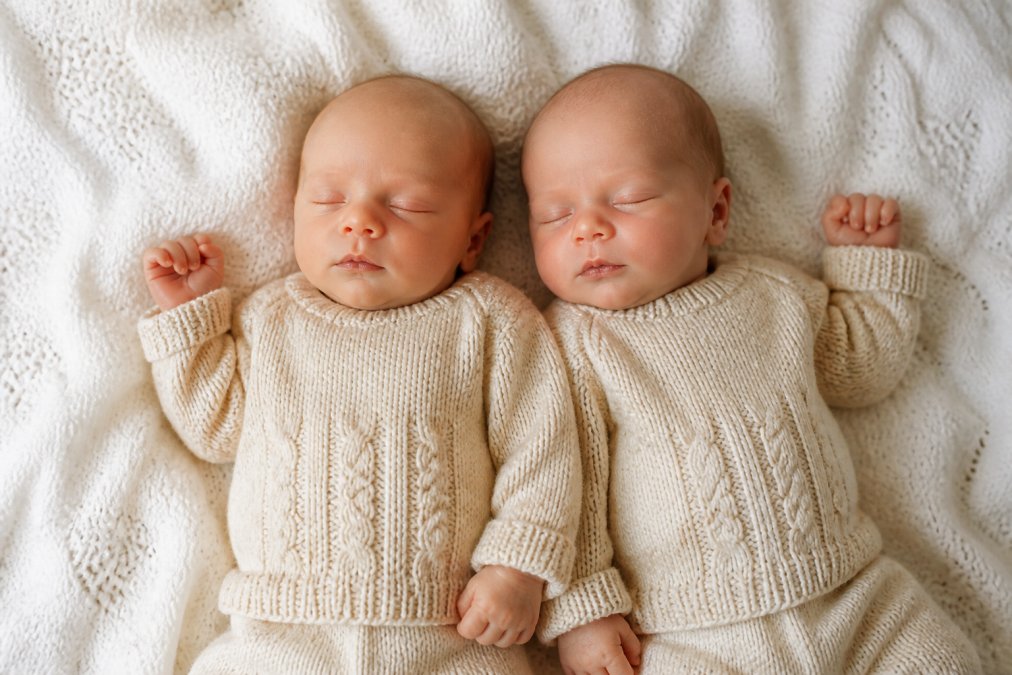
The most important rule: measure each twin separately. Never assume that because they share a birthday, they share a size. Fraternal twins almost always have different chest measurements. Even identical twins can differ by an inch or more in chest circumference within the first weeks of life.
When ordering matching sweaters for twins from Custom Knits for Baby, provide individual measurements for each baby. The design, color, and yarn can be identical; the sizing should be specific to each child. Personalization with each baby's name makes it easy to tell the sweaters apart at a glance.
A few additional considerations for twin orders:
- Order at the same time. Yarn dye lots can vary between separate orders, meaning the sweaters may not match exactly in color if ordered weeks apart.
- Choose the same yarn weight for both. Mixing yarn weights produces sweaters with different drape and texture.
- Add growth allowance to the smaller twin's sweater. If one twin is measuring smaller, size their sweater to the same finished measurements as the larger twin's, or at most one size below.
As noted in the American Academy of Pediatrics' guidance on twin development, growth rates between twins can diverge significantly in the first year, which makes flexible sizing especially important for this age group.
Common Sizing Mistakes to Avoid
The sizing errors that generate the most frustration are almost always preventable.
Ordering by age label alone. Age ranges on knitting patterns are estimates based on average growth charts. A baby at the 90th percentile for weight will not fit a "3-month" sweater at three months. Always cross-reference the age label against actual chest circumference measurements.
Forgetting to account for the head opening. A sweater can have a perfect chest measurement and still be unwearable if the neckline is too narrow for the baby's head to pass through. For hand-knit pieces, the neckline opening should measure at least 12-13 inches in circumference for newborn sizing.
Measuring over thick clothing. Taking chest measurements over a heavy bodysuit adds an inch or more to the reading. Measure over a single thin layer or against bare skin, then add ease separately.
Ignoring blocking. Blocking is the process of wetting or steaming a finished knit piece to set the stitches and open up the fabric to its true dimensions. An unblocked sweater can measure an inch or two smaller than its intended finished measurements. Reputable knitters block their work before shipping, but it's worth confirming.
Assuming identical sizing for twins. Babies grow so quickly that a measurement from six weeks ago may already be outdated.
For more context on infant growth patterns and how they affect clothing sizing, the CDC's infant growth chart resources offer a reliable reference for understanding where a baby falls relative to standard percentiles.
| Common Mistake | What Goes Wrong | The Fix |
|---|---|---|
| Ordering by age label only | Chest doesn't fit current size | Measure chest circumference first |
| Measuring over thick clothing | Reads 1-2 inches too large | Measure over one thin layer |
| Skipping growth allowance | Outgrown in weeks | Add one full size of ease |
| Ignoring neckline opening | Can't get over baby's head | Confirm neckline circumference |
| Same size for twins | One sweater fits, one doesn't | Measure each twin separately |
| No blocking confirmation | Sweater arrives smaller than expected | Confirm knitter blocks before shipping |
Getting newborn sweater sizing right takes a few extra minutes of preparation, but it's the difference between a piece that gets worn and treasured and one that sits folded in a drawer. Custom Knits for Baby crafts each hand-knitted sweater with the softest yarns and personalizes it with your child's name, creating a keepsake that's made to fit and made to last. Provide your baby's actual chest circumference, length, and sleeve measurements when you order, and our team will handle the rest. Order yours today and give your little one a piece that fits from the very first wear.
Frequently Asked Questions
Is newborn size the same as 0-3 months?
No, they are different sizes. Newborn sizing typically fits babies up to about 8 pounds and roughly 17-18 inches long. The 0-3 month size is cut larger, fitting babies from around 8 to 12 pounds and up to 23 inches. In hand knitting patterns, the distinction matters because a true newborn sweater has a smaller chest circumference, shorter body length, and shorter sleeves than a 0-3 month garment. Always check the finished measurements in a pattern, not just the label.
What chest measurement should I use for a newborn hand-knit sweater?
A newborn's actual chest circumference is typically 13-14 inches. For a hand-knit sweater, you add positive ease, usually 1 to 2 inches for a fitted look in a worsted weight yarn, or up to 2.5 inches in bulkier yarn. This means the finished chest measurement on a newborn sweater pattern generally falls between 14 and 16 inches. Always knit a gauge swatch and block it before calculating your finished measurements to make sure your stitch gauge matches the pattern.
How much ease should be added to a hand-knit baby sweater?
Most hand-knit baby sweater patterns include 1 to 2.5 inches of positive ease in the chest. Lighter yarns like DK weight work well with 1 to 1.5 inches of ease for a neat fit. Bulkier yarns add loft and thickness, so less ease, around 0.5 to 1 inch, is often enough. For babies who are between sizes or growing quickly, adding an extra half-inch of ease lets the sweater fit longer without looking sloppy.
How do I measure a baby for a custom knit sweater?
Use a soft fabric measuring tape. Measure chest circumference at the fullest point under the arms, body length from the base of the neck to the hem, sleeve length from the shoulder seam to the wrist, and armhole depth from the shoulder down to the underarm. Record all measurements in inches and note your baby's current weight and age. Share these with your knitter or include them when placing a custom order so the finished measurements match your baby's actual body.