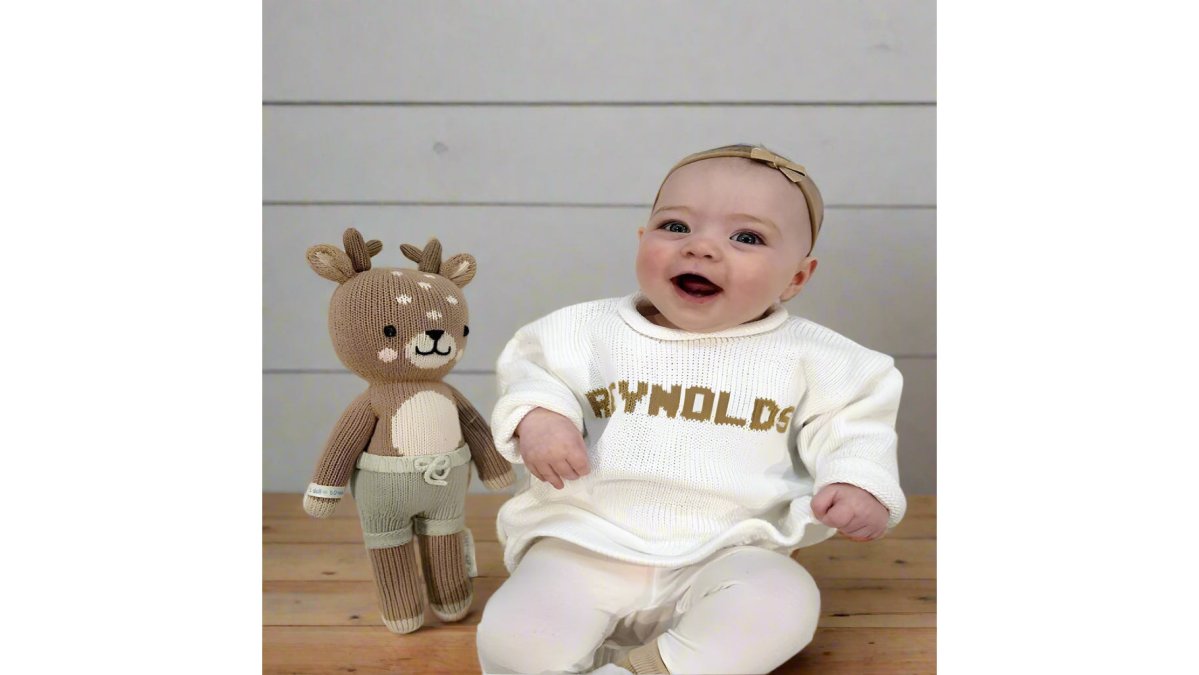
 ultimate-guide
Durable Personalized Clothing for Toddlers: 2026 Guide
Table of Contents
- Why Durable Personalized Clothing for Toddlers Is Worth the Investment
- Best Fabrics for Toddler Clothing Durability
- Personalized Toddler Clothing Sizing Guide
- How to Order Custom Knit Sweaters for Twins
- Customization Options: Embroidery, Monogramming, and Design Tools
- Caring for Personalized Toddler Clothing to Extend Its Life
- Conclusion: Choosing Keepsakes That Actually Get Worn
- Frequently Asked Questions
Last Updated: September 12, 2026
Why Durable Personalized Clothing for Toddlers Is Worth the Investment
Durable personalized clothing for toddlers solves a problem every parent knows: kids lose things, daycare cubbies swallow unnamed sweaters, and cheap knits pill after three washes. This guide from Custom Knits for Baby explains what makes a personalized piece last.

A well-made knit that survives two children costs far less per wear and doubles as a keepsake.
What most buying guides get wrong is treating "personalized" and "durable" as separate decisions. The embroidery or print method affects how the garment washes, and the yarn determines whether the name survives.
Below, we break down fabric durability, sizing, and care so your customized pieces get worn, not stored.
Best Fabrics for Toddler Clothing Durability
The best fabric for toddler durability is a mid-weight 100% cotton knit: it holds shape through repeated washing, breathes, softens with age, and takes embroidery cleanly. But "100% cotton" on a label tells you little about survival. The number that matters is fabric weight, measured in GSM (grams per square meter).
Why GSM Is the Number Most Buying Guides Skip
GSM is the best proxy for how a knit will wear:
- Under 150 GSM: Lightweight jersey, typical of summer tees and cheap promotional blanks. It stretches at the neckline within a season.
- 150-200 GSM: Standard mid-weight cotton and the sweet spot for toddler everyday wear, warm enough for fall and spring, light enough to layer, and stable enough to hold a stitched name.
- 200-280 GSM: Heavyweight fleece and French terry. Excellent for winter sweaters and hoodies, but slower to dry and bulkier on small frames.
- Above 280 GSM: Outerwear territory. Rarely appropriate for a toddler's base layer because it restricts movement.
A 180 GSM cotton knit typically outlasts a 130 GSM one by a wide margin, even when both are labeled "100% cotton (textileexchange.org)." Ask the maker for the GSM.
What Actually Fails First on Toddler Knits
Durability isn't uniform across a garment. Failure points appear in a predictable order:
- Neckline: A rolled or single-stitch neckline stretches into a scoop after a few dozen pulls over a toddler's head. A ribbed, double-stitched neckline holds.
- Cuffs and hems: Ribbed cuffs with spandex recover their shape; plain knit cuffs bag out.
- Underarm and side seams: These take the most friction. Flatlock or reinforced seams outlast basic serged seams.
- Print or embroidery field: The decoration is only as durable as the fabric beneath it. A print on a 130 GSM tee will crack as the fabric stretches; the same print on 180 GSM cotton holds.
Comparing Cotton, Cotton Blends, and Acrylic Yarns
Each yarn type behaves differently on a toddler.
| Yarn Type | Durability | Wash Behavior | Best For |
|---|---|---|---|
| 100% cotton (170-200 GSM) | Holds shape, softens over time | Machine washable, minimal pilling | Everyday wear, embroidery |
| Cotton/poly blend (60/40) | Good shape retention, resists shrinkage | Survives hot washes, dries faster | Budget-conscious families, daycare spares |
| Acrylic | Can pill and stretch | Survives frequent washing | Quick-dry needs, but less breathable |
| Cotton/wool blend | Excellent warmth and recovery | Hand wash or gentle cycle, lay flat | Winter keepsake sweaters |
Acrylic wins on price and drying speed but loses on breathability and comfort against sensitive skin. For a keepsake, cotton is safer; for a daycare spare washed twice a week, a cotton/poly blend is a reasonable compromise.
How to Test Durability Before You Commit
You can't lab-test a garment before buying, but these questions separate durable makers from marketers:
- Ask for the GSM. Anything under 150 for a toddler sweater is a red flag.
- Ask how many wash cycles the maker has tested the decoration through.
- Ask about pilling.
- Ask for a photo of a washed sample. Not a studio shot, a real garment that's been through the laundry.
Eco-Friendly and Non-Toxic Inks and Dyes
Toddler-safe customization starts with what touches the skin. Low-impact dyes and water-based inks avoid the heavy chemical load of some conventional screen printing. Modern water-based inks cure into the fabric and hold up to washing without cracking. For toddler clothing, water-based or discharge inks are the safer default.
Ask any maker which inks and dyes they use, and request the materials list if your child has sensitive skin. If a maker can't tell you what's in their ink, that's your answer.
American Academy of Pediatrics guidance on skin sensitivities in young children
Personalized Toddler Clothing Sizing Guide
Personalized toddler clothing sizing guide basics come down to three measurements: chest, torso length, and sleeve length. Age labels lie. A "2T" from one maker fits like a "3T" from another, so always measure the child, not the label.
How to Measure Your Toddler at Home
You can measure a toddler in under two minutes with a soft tape and a distraction.
- Chest: wrap the tape under the arms at the fullest point, keep it level
- Torso length: measure from the shoulder seam down to the hip bone
- Sleeve: shoulder seam to wrist bone, arm slightly bent
- Add 1-2 inches of growing room for knitwear, since knits stretch
Measure over a light layer, not a bulky outfit. Between sizes, size up for knit sweaters; ribbed cuffs keep oversized sleeves in place.

How to Order Custom Knit Sweaters for Twins
Ordering custom knit sweaters for twins means deciding on matching versus complementary designs before you measure. Twins often wear different sizes at the same age, so size each child individually. Matching sweaters with each child's own name photograph beautifully and prevent the classic twin mix-up at daycare; complementary designs, like the same color with different name styles, let each child keep a distinct identity while still reading as a pair.
When you order, give the maker both names spelled exactly as you want them, plus a pronunciation note if a name is unusual. Spelling corrections after production are costly and sometimes impossible, so confirm details in writing before the order goes to the needles.
U.S. Consumer Product Safety Commission guidance on children's apparel safety
Customization Options: Embroidery, Monogramming, and Design Tools
Custom embroidery and monogramming are durable personalization methods for toddler clothing. A well-stitched name survives years of washing. But the durability difference within each category is larger than the difference between them.
Embroidery: What Makes a Stitched Name Last
Embroidery durability comes down to three variables:
- Stitch count and density. A name stitched at 4,000 stitches is denser and more durable than the same name at 2,000 stitches, but too much density on a lightweight knit can pucker the fabric. The right density depends on the GSM of the garment, another reason fabric weight and decoration method are one decision.
- Backing (stabilizer). Cut-away backing is more durable than tear-away for garments that will be washed frequently. For toddler knits, a soft cut-away or no-show mesh backing prevents the scratchy feel that makes kids refuse to wear a piece.
- Thread type. Polyester thread outlasts cotton thread for wash durability, but cotton thread has a softer hand. Many heirloom knitters use cotton thread and accept a shorter lifespan for the vintage look.
A well-executed embroidered name on a 180 GSM cotton knit can realistically survive many home launderings without visible degradation.
Monogramming: Traditional Format, Modern Considerations
Monogramming is the traditional three-letter format, typically first, last, and middle initials, or first, middle, and last depending on style. It's classic for keepsakes and gifts, but a monogram doesn't identify the child by name the way a full first name does. For daycare cubbies and preschool coat hooks, a full first name in a clean font is more useful than initials.
Monogramming shines on heirloom pieces, christening gowns, first-birthday sweaters, holiday outfits, where the goal is a keepsake, not a daily-wear identifier.
Screen Printing and Direct-to-Garment (DTG)
Screen printing and DTG are the two most common print methods, and they behave very differently:
- Screen printing uses a stencil and squeegee to push ink through a mesh screen. It's durable and colorfast, but each color requires a separate screen, so it's cost-effective only at volume. For a single personalized toddler tee, screen printing is usually overkill.
- DTG (direct-to-garment) prints ink directly onto the fabric like an inkjet printer. It's ideal for one-off personalized designs and full-color graphics, but durability depends heavily on the ink chemistry and the pre-treatment applied to the garment. A well-cured water-based DTG print on 100% cotton can hold up for years; a poorly cured print on a poly blend can fade within a dozen washes.
Heat-Transfer and Vinyl Prints
Heat-transfer and vinyl prints are a common personalization method. A heat-transfer print is a plastic film bonded to fabric with heat and pressure; it cracks along fold lines, peels at the edges, and can't be repaired.
How to Use a Design Tool Without Getting Burned
Many shops offer a custom design tool to preview the name, font, and color before ordering. Use it, but don't trust the screen alone, ask for a photo of a finished piece in a similar style to judge stitch density and letter spacing. In the design tool, watch for three things:
- Font size relative to garment size. A 12-character name in a delicate script font on a 2T bodysuit will be cramped and unreadable. The tool may let you do it anyway.
- Letter spacing. Tight lettering on a small garment can pucker or become unreadable after washing. For toddlers, a clean, slightly larger font wears better.
- Placement. Center-chest placement is standard, but for a toddler who spends most of the day on their stomach or in a car seat, an off-center or shoulder placement can reduce friction and irritation.
Matching the Method to the Mission
For a daily-wear daycare sweater, embroidery in a clean font is right. For a first-birthday photo outfit, DTG or screen printing gives more color flexibility. For a christening gown or heirloom blanket, monogramming in cotton thread is traditional. The method should follow the use case.
Caring for Personalized Toddler Clothing to Extend Its Life

Washing personalized toddler clothing correctly separates a piece that lasts two seasons from one that lasts two children. Turn embroidered garments inside out before washing to protect stitching from friction.
Wash cold on a gentle cycle, and skip the dryer for hand-knitted pieces, heat shrinks cotton and dulls dyed colors. Lay knits flat to dry, reshaping gently while damp. If you must machine dry, use the lowest heat and remove while slightly damp.
Store clean, folded knits away from direct sunlight, which fades yarn and thread. For keepsakes, a breathable cotton bag beats a sealed plastic bin that traps moisture.
Conclusion: Choosing Keepsakes That Actually Get Worn
The real challenge isn't finding personalized toddler clothing; it's finding pieces durable enough to survive playgrounds, daycare, and the washing machine while still looking worth keeping. That balance is what we build at Custom Knits for Baby.
Every sweater is hand-knitted with the softest yarns, personalized with your child's name, and designed to be worn hard and treasured long after. With ribbed cuffs, 100% cotton construction, and designs for babies and adults, our pieces are made to be handed down, not put away.
Order yours today and give your little one something warm, personal, and built to last.
Frequently Asked Questions
What materials are best for durable toddler clothing?
Look for 100% cotton or cotton-rich blends with a tight knit. Cotton breathes well, holds up to repeated washing, and feels soft against sensitive skin. Avoid loosely knit acrylics that pill after a few wears. For personalized toddler clothing, embroidery on cotton yarn tends to outlast screen printing. Check the fabric weight too; heavier knits resist snags better on the playground.
How do I choose the right size for personalized toddler sweaters?
Measure your toddler's chest, height, and arm length rather than relying on age labels. A 2-year-old may fit 2T or 3T depending on build, so always check the brand's specific size chart. If your child is between sizes, size up for knitwear since toddlers grow quickly and a slightly roomy sweater can be layered. Custom Knits for Baby offers sizes for infants through children, so you can match measurements to the chart before ordering.
Are personalized knit sweaters safe for active toddlers?
Yes, when they are made from soft, breathable yarns and have no loose threads or small detachable parts. Avoid drawstrings and long ties that can catch on playground equipment. Embroidered names are stitched directly into the fabric, so there is nothing to pull off. Always supervise your toddler, and check the sweater periodically for loose yarn or stitching that could wrap around fingers or toes.
What is the difference between screen-printed and embroidered toddler clothing?
Screen printing applies ink to the fabric surface. Embroidery stitches the design into the garment, so it moves with the fabric and typically lasts the life of the sweater. For toddlers who wear and wash their clothes frequently, embroidery is the more durable choice. It also gives a raised, textured look that many parents prefer for keepsake items like name sweaters.