 how-to
Custom Military Theme Baby Apparel: 2026 Guide
Table of Contents
- Why Military Families Love Custom Baby Apparel
- Personalized Military Baby Gifts for Homecomings and Showers
- How to Measure Baby for Custom Clothing
- How to Order Custom Knit Sweaters for Twins
- Fabric Safety and Durability for Sensitive Skin
- Upcycling Military Uniforms into Baby Keepsakes
- Caring for Custom Embroidery and Camo Apparel
- Frequently Asked Questions
Last Updated: September 10, 2026
Why Military Families Love Custom Baby Apparel
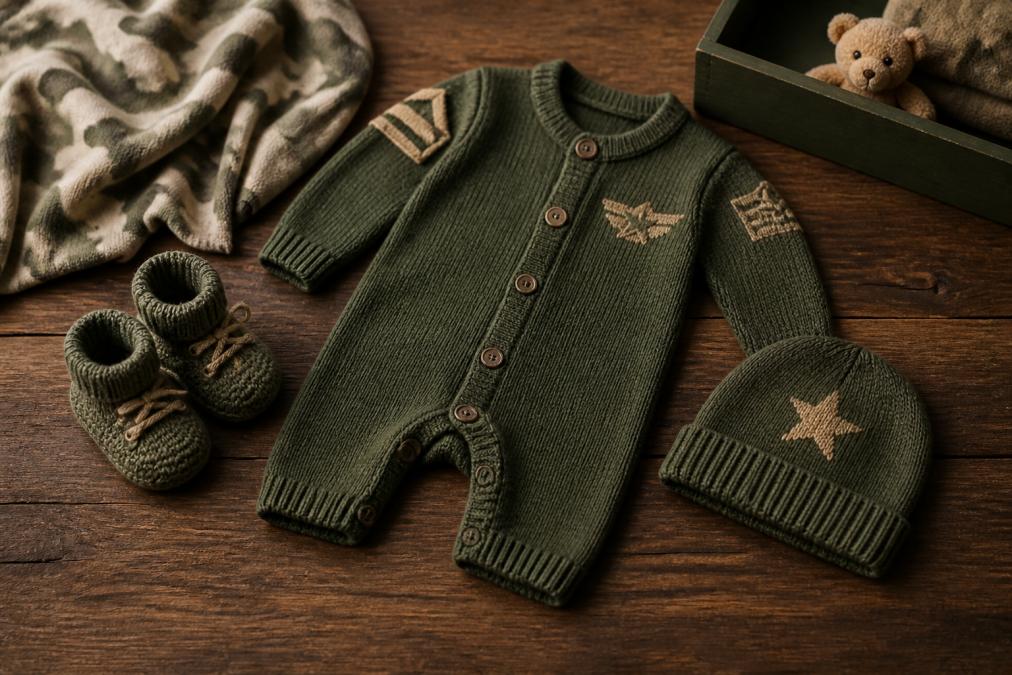
Custom military theme baby apparel is clothing made specifically for infants that incorporates service branch colors, insignia, or wording, allowing military families to dress a newborn in a design that reflects a parent's service. For families who move every few years, this clothing carries a sense of identity that travels with them.
At Custom Knits for Baby, we offer beautifully hand-knitted, personalized sweaters designed to keep your little ones warm and stylish. Each piece is crafted with the softest yarns and customized with your child's name, creating a unique and timeless keepsake.
Families are searching for designs that reflect their unique stories. Below, we'll show you exactly how to choose, size, and care for these pieces so they survive more than one baby.
Branch-Specific Designs for Every Service Member
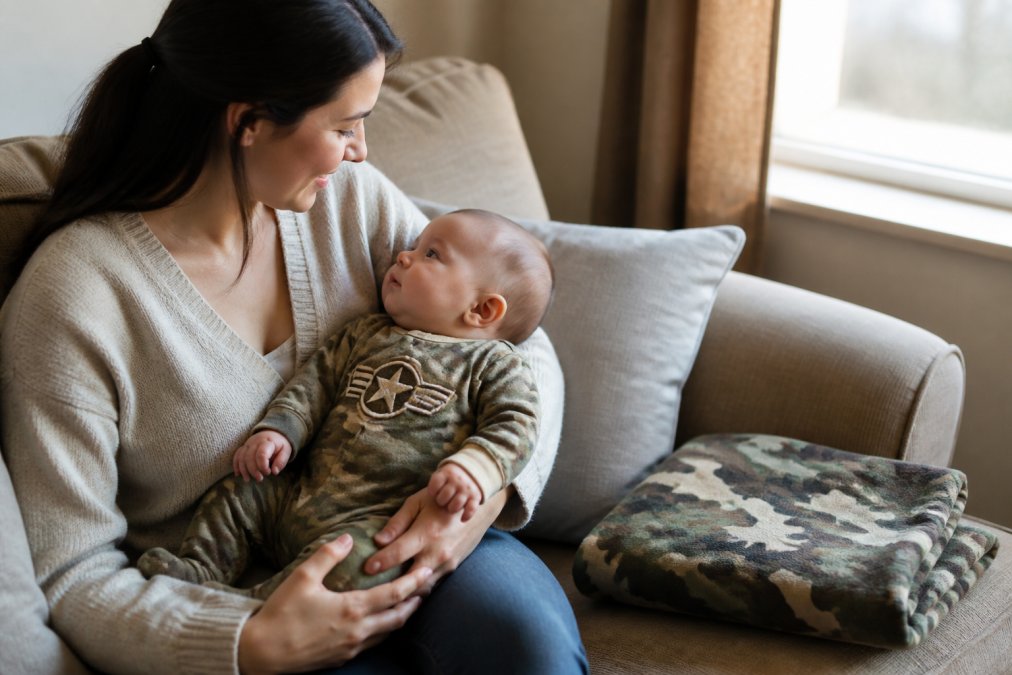
Each branch has its own visual language, and getting it right matters to the families who wear it. Army designs lean on olive drab, subdued patches, and star motifs. Navy pieces often use navy and gold with anchors or ship silhouettes. Air Force apparel tends toward silver and blue with wings. Marine Corps designs use scarlet and gold with the eagle, globe, and anchor. Coast Guard pieces favor orange and navy with a rescue or shield theme.
A common approach is to focus on one branch, one palette, and one motif, then let the personalization carry the rest.
Personalized Military Baby Gifts for Homecomings and Showers
Personalized military baby gifts work best when the design ties to a specific moment: a homecoming, a promotion, or a shower held while a parent is deployed. Popular items include knit sweaters with the baby's name.
Timing drives most of these purchases. If you need a gift for a shower in three weeks, order early and confirm the production window before you check out, because hand-embroidered pieces take longer than screen-printed ones. Ask the maker directly what their current turnaround is.
Embroidery and Screen Printing Options
Embroidery and screen printing solve different problems. Embroidery stitches thread directly into the fabric, which makes it durable, textured, and ideal for names, monograms, and small branch insignia. Screen printing lays ink on the surface, which suits large flat graphics, bold US flag blocks, and lower-cost runs.
For baby apparel, embroidery can be a durable choice as it stitches thread directly into the fabric. Screen printing lays ink on the surface.
How to Measure Baby for Custom Clothing
Measuring a baby for custom clothing takes about two minutes and prevents the most common sizing complaint: a garment that fits the length but not the chest. Use a soft tape measure and record three numbers, then compare them to the maker's size chart rather than assuming a standard size.
- Chest: measure around the fullest part, under the arms, keeping the tape snug but not tight
- Length: measure from the top of the shoulder to the bottom of the heel for full-body pieces
- Weight: always note current weight, since knit sizing often follows weight more closely than age
- Head circumference: needed for any pullover sweater that goes on over the head
Write these numbers down and keep them, because babies change fast and a reorder six weeks later will need fresh measurements.
Sizing Tips for Preemies and Newborns
Preemie sizing can be challenging. A garment labeled "newborn" is typically built for roughly 7 to 9 pounds (healthychildren.org). If you're ordering for a preemie, ask the maker for their smallest available size and share the baby's current weight and length rather than an age.
For newborns, choose a romper or bodysuit with a wide neckline and snap closures at the bottom. These features make diaper changes faster and reduce the chance of stretching a hand-knit collar out of shape.
How to Order Custom Knit Sweaters for Twins
Ordering custom knit sweaters for twins comes down to sequencing: measure both babies, order both pieces in the same production run, and decide in advance whether you want matching or coordinating designs. Matching means identical color and motif. Coordinating means the same theme in two different colorways, which some families prefer so each child has something of their own.
When you place the order, give the maker both names spelled exactly as they should appear, plus a note on which sweater belongs to which baby. A hand-knit piece with two names stitched in the wrong order can be challenging to fix, and reworking embroidery can be slower than getting it right the first time.
Fabric Safety and Durability for Sensitive Skin
Fabric choice matters more for babies than for almost any other wearer. A newborn's skin is thinner and more permeable than an adult's, so rough wool blends, heavy dyes, and scratchy seams can trigger irritation (healthychildren.org). Soft cotton, cotton blends, and fine merino are the safest bets, and any garment that touches the face should be smooth against the skin.
Durability and softness pull in opposite directions, which is why fiber content matters. Tightly spun cotton holds up to repeated washing but can feel firmer at first. Looser knits feel gentler but pill faster. Ask the maker for the exact materials list if your baby has reacted to fabrics before, and check the American Academy of Pediatrics guidance on infant skin care for general advice on what to avoid.
If you're upcycling a uniform into baby clothing, wash the fabric thoroughly before it's cut, and confirm that any treatment applied to the original garment has fully broken down. Military uniforms often carry stain-resistant or insect-repellent finishes that you do not want against an infant's skin.
Upcycling Military Uniforms into Baby Keepsakes
Upcycling a uniform turns a stored item into something a child can actually wear, and it is the angle most guides skip entirely. The usual candidates are a service member's old combat shirt, a set of fatigues, or a dress uniform that no longer fits. The fabric is durable and already meaningful. What follows is the how-to, the safety considerations, and the legal points.
Step 1: Choose the Right Garment
Not every uniform is a good candidate. The best pieces are those with large, intact panels of fabric and minimal wear. Combat shirts and trousers usually offer the most usable material. Dress uniforms are often the most sentimental but the least forgiving to cut, because the fabric is tailored and the panels are small.
Avoid garments with heavy staining, fraying, visible repairs, or significant sentimental value that would be damaged by cutting. If the uniform is the only one of its kind in the family, consider having a professional do the cutting and stitching rather than attempting it yourself.
Step 2: Check the Fabric Finish Before You Cut
Many military uniforms carry durable finishes applied at the factory, including stain-resistant treatments, insect-repellent treatments, and in some cases flame-resistant treatments. These finishes are designed for adult wear in field conditions, not for an infant's skin.
Before cutting, wash the garment thoroughly according to its care label, using a mild detergent and no fabric softener. If the finish does not break down after repeated washing, do not use that fabric against a baby's skin. When in doubt, use the uniform fabric for an outer layer such as a bib or a blanket rather than a bodysuit that sits directly against the skin.
Step 3: Confirm You Are Allowed to Use It
Most uniforms that have been properly separated from service are fine to repurpose for personal, non-commercial use. The rules tighten when a garment still carries official insignia, name tapes, or unit patches, and they tighten further if you intend to sell the finished piece. As a general rule, personal keepsakes for your own family are the safest use, and commercial resale of items bearing official insignia is where families run into trouble.
If you plan to sell upcycled pieces, remove or cover official insignia and do not imply any official endorsement or affiliation. When in doubt, consult the branch's public affairs office or a legal advisor before you list an item for sale.
Step 4: Plan the Cut
Use fabric from the largest, least-worn panels first, typically the back and lower legs. Keep at least one intact patch or name tape for the finished piece, because that detail is what makes the keepsake recognizable. Lay out your pattern pieces before you cut so you can confirm you have enough fabric for the size you want.
A common pattern is to use the uniform fabric for the body of a bodysuit or romper and a soft cotton or cotton blend for the lining and the areas that touch the baby's face and neck. This gives you the durability and meaning of the uniform fabric without putting a rugged material against sensitive skin.
Step 5: Finish and Personalize
Have a professional do the final stitching if the uniform is sentimental. A seamstress who works with heavy fabrics will know how to handle the weight and how to finish seams so they do not scratch. Pair the uniform-fabric piece with a name embroidered on the chest, which gives the piece a personal anchor and ties it to the baby rather than only to the service.
What to Expect on Cost and Timeline
Upcycling can involve higher labor and non-standardized fabric. A maker who takes on a uniform upcycle may charge more than for a standard custom order and may need a longer production window. Ask for both numbers before you commit, and confirm whether the maker has worked with uniform fabric before.
The result is a keepsake that carries a real story rather than a printed approximation of one. Many families pair a uniform-fabric bodysuit with a name embroidered on the chest, which gives the piece a personal anchor.
Caring for Custom Embroidery and Camo Apparel
Caring for custom military theme baby apparel is simpler than most parents expect, but the rules differ from ordinary baby clothes. Turn embroidered pieces inside out before washing, use cold water on a gentle cycle, and skip the dryer. Heat is what shrinks knits, fades camouflage prints, and distorts stitched lettering.
- Wash embroidered items inside out in cold water
- Use a mild, fragrance-free detergent
- Lay flat to dry; never tumble dry a hand-knit
- Iron around embroidery, never directly on top of it
- Store folded, not hung, to protect shoulder shape
A quick summary of what to watch for:
| Problem | Likely Cause | Fix |
|---|---|---|
| Stitching puckers | Washed in hot water | Cold wash, lay flat to dry |
| Camo print fades | Dryer heat | Air dry only |
| Knit stretches out | Hung on a hanger | Store folded |
| Name tape lifts | Ironed directly | Iron around the patch |
| Fabric feels stiff | Thick screen print | Switch to embroidery |
Treat the first wash as a test. If a piece comes out looking the same as it went in, it suggests durability.
Military families are balancing two things at once: the pride of service and the everyday reality of dressing a newborn who will outgrow everything in months. Custom Knits for Baby exists for exactly that tension, offering hand-knitted sweaters personalized with your child's name, made with soft yarns and built to be kept rather than discarded. Whether you're ordering a single piece for a homecoming or a matching set for twins, you can choose a design that honors the service and still gets worn every week. Order yours today and give your little one something worth passing down.
Frequently Asked Questions
Where can I find custom military-themed baby clothes?
You can find them through specialty handcrafted baby brands like Custom Knits for Baby, which offers personalized knitwear featuring branch-specific designs. Look for options that include embroidery, screen printing, and camo patterns. Many brands also let you add your baby's name or birth stats. Check for materials like soft cotton or acrylic blends that are gentle on newborn skin. Ordering early is smart, especially for baby shower gifts or homecoming events.
How do I personalize a baby sweater with a military theme?
Start by choosing a design that reflects your service branch, such as Army, Navy, Air Force, Marine Corps, or Coast Guard. Then select a customization method: embroidery works well for names and dates, while screen printing suits bold graphics like flags or insignia. Provide accurate sizing measurements and allow time for production. Many brands offer proof approval before stitching, so you can catch errors early. Always confirm the yarn or fabric is safe for sensitive skin.
Can I use military uniform fabric for baby clothes?
Yes, upcycling a retired uniform into baby apparel is a meaningful way to create a keepsake. The fabric is durable, but it may be too stiff for a newborn's sensitive skin, so it's often used for accents, patches, or outer layers rather than garments worn directly against the body. Work with a seamstress experienced in repurposing uniforms, and always wash the fabric thoroughly before sewing. This approach works well for memory items like blankets or rompers.
How do I choose the right size for custom baby apparel?
Measure your baby's chest, length, and weight, then compare against the brand's size chart. Newborn sizes fit up to about 8-10 pounds, while 0-3 months suits babies up to roughly 12-14 pounds. For preemies, look for brands that offer preemie sizing or adjustable knits. If your baby is between sizes, size up for growth room. Custom knitwear often has some stretch, so a slightly larger fit can last longer without looking baggy.