 ultimate-guide
Choosing the Right Size Baby Sweater: A Guide
Table of Contents
- Why Getting the Right Size Matters for Baby Sweaters
- How to Measure Your Baby for a Sweater
- Reading a Baby Sweater Size Chart
- Sizing Up Baby Clothes for Growth Spurts
- Yarn Weight, Gauge, and Fit Considerations
- Seasonal Sizing and Layering
- Choosing the Perfect Handcrafted Sweater for Your Baby
- Frequently Asked Questions
Last Updated: September 26, 2026
Why Getting the Right Size Matters for Baby Sweaters
A sweater that's too tight restricts movement; one too loose defeats its purpose. But choosing the right size baby sweater maximizes garment longevity and wear time.
Proper sizing, accounting for growth and fit, transforms a custom made sweater into a keepsake your child grows into and eventually passes down.
How to Measure Your Baby for a Sweater
Accurate measurements are the foundation of choosing the right size baby sweater: chest circumference, back length, arm length, and neck-to-wrist distance.
Chest Circumference and Arm Length
Chest circumference determines fit across the torso. Wrap a soft measuring tape gently around the fullest part of your baby's chest, just under the arms, keeping it flat but relaxed.
Arm length determines sleeve fit. Measure from the center back of the neck, across the shoulder, and down to the wrist.

Back Length and Sleeve Length
Back length (base of neck to hip) prevents the sweater from riding up or hanging too far. Sleeve length (shoulder seam to wrist) ensures proper coverage.
Sleeves too short won't keep hands warm; sleeves too long create a safety hazard with excess fabric catching on objects.
Neck-to-Wrist Measurements
Neck-to-wrist distance is a shortcut measurement: start at the base of the neck and measure straight down to the wrist. This single measurement often proves more reliable on a wiggly baby than separate arm and back measurements.
Reading a Baby Sweater Size Chart
A quality size chart shows finished garment dimensions, the actual width and length after the sweater is made, not age ranges.
Age-Based vs. Measurement-Based Sizing
Age-based sizing is imprecise; a "6-12 months" label assumes uniform proportions when babies vary widely.
Measurement-based sizing uses actual chest circumference and length, accounting for your individual baby's growth pattern rather than an average.
When choosing the right size baby sweater, use measurement-based sizing and treat age as a reference only. If your baby has a 20-inch chest, find the size for a 20-inch chest regardless of age label.
Understanding Positive and Negative Ease
Ease is the difference between your baby's body measurement and the finished garment measurement. Positive ease means the sweater is larger than your baby's body.
Most baby sweaters are designed with 2-3 inches of positive ease, providing room for layering and movement without looking oversized.
Sizing Up Baby Clothes for Growth Spurts
Babies grow in unpredictable bursts. The question is whether to buy for current size or size up to extend wear time.
Sizing up one size typically adds 3-4 months of wear; fast growers may need two sizes up.
The trade-off is fit: oversized sweaters look sloppy, don't insulate effectively, and create bulk rather than warmth.
Size up so your baby grows into the sweater within 4-6 weeks, achieving perfect fit, then wearing it another 2-3 months before outgrowing it.
Yarn Weight, Gauge, and Fit Considerations
The yarn weight and gauge of a custom made sweater directly impact how it fits, how it wears over time, and ultimately how long your baby can wear it. These aren't just technical specifications, they're the foundation of whether a sweater will maintain its shape through growth and repeated washing.
Understanding Yarn Weight and Its Effect on Sizing
Yarn weight affects drape, breathability, and stretch. Soft cotton ranges from fingering weight (very fine) to worsted weight (medium-heavy).
Lighter-weight soft cotton creates breathable sweaters ideal for warm months but may show wear quickly. Medium-weight balances durability with softness. Heavier-weight provides winter insulation.
Yarn weight affects positive ease: lighter-weight with loose gauge may stretch, so use 1-2 inches of positive ease; medium-weight holds shape better with standard 2-3 inches.
Personalized Baby Name Sweater with →
Gauge: The Hidden Sizing Variable
Gauge (stitches and rows per inch) is the most important factor in determining finished dimensions, yet it's often overlooked.
Two "size 12 months" sweaters may have different finished chest measurements at different gauges. Tighter gauge (more stitches per inch) is denser and holds shape; looser gauge is airier but may stretch out.
Always ask for gauge specification. A quality size chart includes finished dimensions and the gauge used. Match to finished dimensions, not size labels.
Medium to slightly tight gauge in soft cotton is ideal: it provides durability, resists stretching, and maintains fit as your baby grows.
How Gauge Affects Growth and Longevity
Tighter gauge maintains fit longer: denser fabric resists premature stretching, so positive ease stays consistent over months.
Custom made sweaters that hold their shape can be worn by multiple children or saved as keepsakes without looking worn out.
When choosing the right size baby sweater, ask about yarn weight and gauge. Medium gauge soft cotton balances durability, fit longevity, and comfort.
Seasonal Sizing and Layering
Season fundamentally changes sizing: a spring sweater over a lightweight onesie requires different sizing than a winter sweater over thermal layers.
Spring and Summer Sizing
In warmer months, babies wear minimal layers underneath. A typical outfit might be a short-sleeved onesie or bodysuit with the sweater on top. For this scenario, you want a sweater that fits closer to your baby's actual chest measurement with minimal positive ease, aim for 1-2 inches of positive ease rather than the standard 2-3 inches.
Why? Excess fabric in warm weather traps heat and can make your baby uncomfortable or cause overheating. A sweater that's fitted but not snug allows air to circulate while still providing a protective layer. It also looks proportional on your baby rather than oversized.
When measuring for a spring or summer sweater, take your baby's chest circumference and add only 1-2 inches. If your baby measures 18 inches around the chest, look for a sweater with a finished chest measurement of 19-20 inches. This gives you a comfortable fit without excess bulk.
Fall and Winter Sizing
In cooler months, layering is essential. Your baby will wear a long-sleeved shirt or thermal layer underneath the sweater, and possibly a second layer on top. This changes the sizing equation significantly.
For fall and winter, you can size up to accommodate layering underneath. Plan for 3-4 inches of positive ease instead of 2-3. If your baby measures 18 inches around the chest, look for a sweater with a finished chest measurement of 21-22 inches. This extra room allows a long-sleeved shirt to sit comfortably under the sweater without bunching or restricting movement.
Pay special attention to sleeve length in winter. Sleeves that are slightly longer (ending just at or slightly past the wrist) work better over long-sleeved layers.
Planning for Year-Round Wear
If you're ordering a sweater that will be worn across multiple seasons, size for the season when your baby will wear it most frequently. If you're buying a sweater in September that will be worn heavily from October through March, size for winter layering (3-4 inches of positive ease). The sweater will be slightly loose in early fall, but it will fit perfectly once the weather cools and layering begins.
Sleeve Length Across Seasons
Sleeve length is particularly sensitive to seasonal changes. In summer, you want sleeves that end right at the wrist, leaving hands free and unencumbered. In winter, sleeves that end just slightly past the wrist (about ½ inch) work better because they'll sit at the wrist once a long-sleeved shirt is layered underneath.
Growth Spurts and Seasonal Transitions
Babies often have growth spurts that coincide with seasonal changes. A baby who's been in a size for several months might suddenly outgrow it right as the season changes. This is why understanding seasonal sizing helps you plan ahead.
Choosing the Perfect Handcrafted Sweater for Your Baby
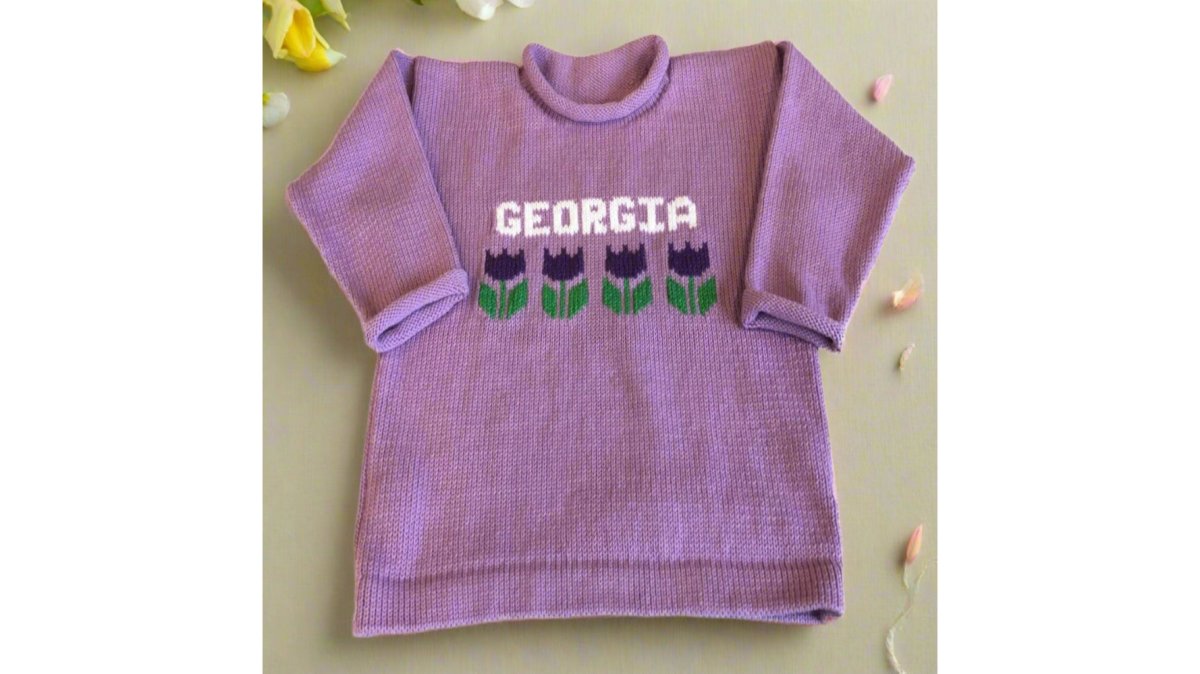
A custom made sweater from Custom Knits for Baby is built to last far longer than mass-produced alternatives. Each piece is custom made with soft cotton yarn, with your baby's name or a meaningful motif knitted directly into the fabric, stitch by stitch. Nothing is printed or added afterward, so it cannot peel, crack, or fade in the wash.
Frequently Asked Questions
Is it better to size up or down when buying a baby sweater?
Size up rather than down. Babies grow quickly, and a snug sweater becomes unwearable in weeks. A slightly loose fit allows room for growth spurts and layering. Positive ease (extra room built into the design) ensures comfort and extends how long your baby can wear the sweater. Most parents find that sizing up by one size category adds 3-6 months of wearability.
How do I measure my baby for a custom-made sweater?
Measure chest circumference across the widest part of the chest, back length from the base of the neck to the desired hem, arm length from the shoulder seam to the wrist, and neck-to-wrist measurement from the base of the neck down the arm to the wrist. Use a soft measuring tape and keep your baby relaxed. Write measurements in inches for accuracy when ordering custom made sweaters like those from Custom Knits for Baby.
What are standard chest measurements for different baby sweater sizes?
Newborn sweaters typically measure 16-18 inches across the chest, 6-month sizes 18-20 inches, 12-month sizes 20-22 inches, and toddler sizes 22-24 inches or larger. However, these are guidelines, actual measurements vary by design and yarn weight. Always check the specific baby sweater size chart for the garment you're considering, as handcrafted pieces may have different finished dimensions than mass-produced options.
How does yarn weight affect how a baby sweater fits?
Yarn weight influences the finished dimensions and drape of a sweater. Lighter-weight yarns create more fitted garments, while heavier yarns produce looser, bulkier sweaters. The gauge (stitches per inch) also matters, a tighter gauge creates denser fabric that may fit smaller, while a looser gauge produces more stretch. When choosing a custom made sweater, ask about yarn weight and gauge to predict how the finished garment will fit your baby.